Texas A&M AgriLife DAR Specialists Certified to Lead National Youth Preparedness Program 

By: Jordan Baze, Disaster Assessment and Recovery Unit, Recovery Coordinator and Sara Allen, Disaster Assessment and Recovery Specialist, Texas A&M AgriLife Extension Service

MyPI logo

Twenty-one Disaster Assessment and Recovery (DAR) Specialists from the Texas A&M AgriLife Extension Service have been officially certified as instructors for MyPI (My Preparedness Initiative), a groundbreaking national youth preparedness program. With instructor certification, these specialists will now lead efforts across Texas communities to train and inspire the next generation of emergency preparedness leaders. 

MyPI is setting a new national standard for youth preparedness education by blending leadership development with hands-on emergency training. Aimed at teens aged 13–19, the program is designed to prepare young people to take meaningful action during disasters—equipping them not only with critical lifesaving skills but also instilling a strong sense of civic responsibility. 
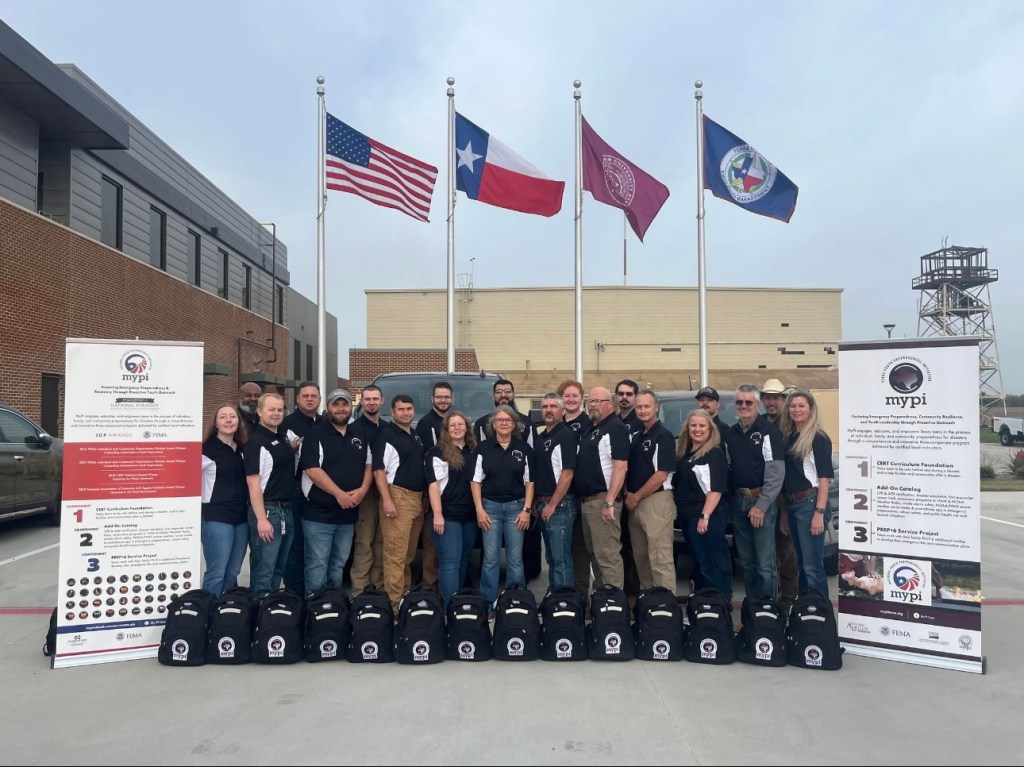
MyPI Instructors
Screenshot

At the heart of the MyPI curriculum is the FEMA Community Emergency Response Team (CERT) training, which includes key modules on Disaster Preparedness, Fire Safety, Utility Control, Medical Operations, Light Search and Rescue, CERT Organization, Disaster Psychology, and Terrorism Awareness. The program also includes certification opportunities in CPR and AED usage, and education in emergency communications such as HAM Radio and NOAA Weather Radios. 

Participants will also explore digital tools and smart technology for emergency response, with a special emphasis on social media and mobile apps. A school safety module, based on the widely respected CRASE (Civilian Response to Active Shooter Events) curriculum, further enhances readiness in the school environment. 

MyPI Fire Training

The program’s most impactful component is Prep + 6—a family and community service project in which each student assembles an emergency supply kit and family communication plan for their own household and six additional families. This multiplier effect significantly strengthens community resilience and fosters a culture of preparedness across neighborhoods. 

As these newly certified instructors return to their assigned districts, they will coordinate with local County Extension staff to begin recruiting and training Texas youth in disaster readiness, leadership, and emergency response. The goal is not only to prepare for the worst but to empower teens to be a part of the solution when disaster strikes. 

To learn more or get involved, visit mypitexas.org

Kentucky Extension Fortifies Disaster Response with Innovative Strike Teams, Backed by EDEN Grant

LEXINGTON, Ky. – Recognizing the escalating threat of billion-dollar weather disasters, the University of Kentucky Cooperative Extension has launched strategically developed Kentucky Extension Strike Teams to bolster the state’s disaster preparedness and response capabilities. This critical initiative was made possible through a recent development grant from the Extension Disaster Education Network (EDEN).

The urgency of this effort is underscored by the stark reality of 2023, which saw 28 separate weather or climate disasters across the United States, each inflicting at least $1 billion in damages. In Kentucky alone, the frequency of such events is on the rise. According to UK Meteorologist Matt Dixon, “Kentucky has experienced a disturbing increase in ‘Billion’ dollar weather disasters – a total of 84 since 1980, with 5 of those devastating events occurring in 2022 alone.”

Leveraging the EDEN grant, the University of Kentucky Cooperative Extension proactively addressed the pressing need for a more coordinated and effective disaster response framework. The cornerstone of this effort is the establishment of regional Extension Strike Teams. These specialized teams, composed of trained county agents and staff, will provide crucial on-the-ground support to communities impacted by disasters.

The project encompassed a comprehensive approach, including the recruitment and specialized training of extension professionals. In collaboration with EDEN, Kentucky Emergency Management, and the Kentucky Department of Public Health, the project team meticulously developed clear position descriptions and targeted training materials. Regular, realistic training exercises are integral to ensuring the teams are deployment-ready.

A significant and far-reaching outcome of this grant is the creation of a comprehensive toolkit designed to empower other states in developing their own Extension Disaster Strike Teams. This valuable resource includes practical guidance on recruitment strategies, detailed training checklists, effective team development methodologies, suggested training modules, and partnership cultivation strategies.

“This initiative will allow Extension leaders to learn from established strike team models and, crucially, implement a pilot strike team program within Kentucky Cooperative Extension,” explained Jeffery Young, project team leader. “Furthermore, the development of a national toolkit will provide a roadmap for other states to build their own resilient disaster response networks.”

The impact and effectiveness of the Kentucky Extension Strike Teams will be rigorously evaluated through data gathered at meetings and training sessions, complemented by agent feedback collected via online evaluation forms. This commitment to continuous improvement will ensure the ongoing success and adaptability of the program.

EDEN Executive Team Mid-Winter Meeting Recap: Key Strategies for Enhancing Communication and Collaboration

By Soni Cochran, Marketing and Membership Committee Chair

The EDEN Executive Team met in Irvine, California, February 25-28 for the annual mid-winter meeting, focusing on how to improve communication and collaboration across the network. Some key topics included ways to improve communication and provide better resources for committee chairs, Points of Contact (POCs), and delegates. They also discussed setting up onboarding opportunities for new delegates and POCs.

The team also worked on refining the operating guidelines to clarify training, committee structures, and job descriptions for committee chairs and vice-chairs, making sure everything aligns with EDEN’s mission. A task force has been formed to develop resources to help both new and current members communicate the value of EDEN to Extension Administrations.

To improve collaboration, the Executive Committee and the FADI team plan to have bi-weekly check-ins, which will help with coordination and reporting across EDEN’s initiatives. The team also discussed the EDEN All-Hazards Resource Dashboard on the website. Featured resources like “What to Do After a Disaster” and materials supporting Extension’s role at the state level are needed. The team is working on improving the dashboard’s search features, making sure resources are up-to-date, easy to find, and clearly separate from those of member institutions. The EDEN membership database is being reviewed to ensure that only current delegates are listed.

These efforts are designed to strengthen EDEN’s role in supporting Extension faculty, staff, and stakeholders throughout all phases of disaster and emergency response—preparedness, mitigation, response, and recovery—while ensuring critical resources are shared across the network. The next strategic planning session for the EDEN Executive Team is scheduled for July 9-11.

USDA Assists Farmers, Ranchers and Communities Affected by Weekend Windstorms

From the March 19, 2025 NIFA Update

U.S. Secretary of Agriculture Brooke Rollins announced earlier this week that USDA will deliver any assistance it can for communities and agricultural producers affected by the weekend storms that cut a path of devastation through the South and Midwest.

Cooperative Extension, based at Land-grant Universities, serves as a vital conduit for resources and expertise related to preparedness, recovery and mitigation for many types of disasters.

Extension efforts are bolstered by the Extension Disaster Education Network (EDEN). Supported by USDA’s National Institute of Food and Agriculture, EDEN is a collaborative national effort by Extension services across the country to improve the delivery of services to people affected by disasters. EDEN’s mission is to reduce the impact of disasters through research-based Extension education. Additionally, EDEN ensures that Extension can respond to local, state, regional and national education needs during a crisis.

EDEN’s website provides Extension professionals with access to resources on disaster preparedness, recovery, and mitigation to enhance their programming efforts. EDEN also maintains a shared database of disaster-related resources that are available from member states. While it was designed for use by Extension agents and educators, anyone can access these resources. 

Meet the 1890 Extension Disaster Education Network Advisory Group

The Extension Disaster Education Network (EDEN) consists of Cooperative Extension professionals from across the nation working to help communities improve the delivery of services to citizens affected by disasters. Within this organization, a smaller group of professionals with a specific mission, play a vital role in helping limited resource clientele during disasters. This group is known as the 1890-EDEN Advisory Group (AG). The EDEN AG is a collaboration of 1890 Land-grant Universities that function within the national EDEN. The 1890 Land-grant Universities are the 19 Historically Black Colleges and Universities located primarily in the southern region of the United States.

Dr. Noel M. Estwick

Dr. Noel M. Estwick

Dr. Noel M. Estwick, assistant professor of agribusiness and research scientist for Prairie View A&M University, (PVAMU) is the principal investigator for the 1890-EDEN project. He recently shared important information about the 1890-EDEN AG to acclimate EDEN members about the group’s origin and accomplishments. Below is a question-and-answer session highlighting the conversation.

When and how did the 1890 EDEN AG begin?

Estwick: The 1890-EDEN AG began in 2017 with a grant from the EDEN Executive Committee to me at (PVAMU). A sub-award was issued to Finis Stribling III from Tennessee State University. The project title was “Exploring the Needs for 1890-EDEN Growth.” Consequently, in 2017, I was hosted by Beverly Samuels, U.S. Department of Agriculture (USDA) National Institute for Food and Agriculture (NIFA) National Program Leader for the Division of Family & Consumer Sciences to participate in the Visiting Scholar Program. Stribling and I worked with the EDEN Executive Committee, the 1890 Association of Extension Administrators (AEA), and the other the 1890 network institutions. We also worked along with 1862 partners to assemble the first 1890-EDEN AG meeting. This took place at the PVAMU Northwest Houston Center from May 30 to June 2. Attendees included 21 Extension professionals representing 13 1890 institutions.

Share some of the success stories, highlights or impacts of the EDEN 1890 AG since its creation?

The group met on the campus of North Carolina A&T University August 2024.

Estwick: The AG hosts an annual face-to-face meeting to conduct training and strategic planning. Members have presented webinars and created an action plan which serves as the roadmap for AG initiatives. We have also conducted trainings for the EDEN post-conference and collaborated with our 1862 EDEN partners to conduct trainings in Illinois and Mississippi. In addition, we have worked with other academic institutions, federal and nonfederal partners to conduct trainings in family preparedness, family estate planning and COAD Development and Maintenance.

In February 2024, the AG hosted a bootcamp for producers that included sessions on crisis communication for disasters, mental health and well-being in disasters, assessing and planning for agricultural risks and disasters recovery resources for producers.

Photos from the producer boot camp in Atlanta, Georgia, February 2024.

AG institutions have partnered to respond to requests for proposals and successfully received two externally funded grants from Southern SARE and one EDEN development grant. In addition, the AG partnered with the Texas A&M University System and the Texas Division of Emergency Management to host the 2023 Preparedness, Response to, Innovation on Mitigation of, and Recovery (PRIMR) Conference on the campus of PVAMU. This unique conference brings emergency management practitioners, allied professionals, researchers, educators, students and community leaders together to share disaster best practices, lessons learned, or not yet learned, and insights from all dimensions of disaster readiness.

Describe some of the goals, objectives of the AG?

Estwick: The overarching goal of the AG is to facilitate oversight and re-engagement of the 1890 institutions in national EDEN. Objectives include working with USDA-NIFA and EDEN on strategies to build emergency management capacity in the 1890 community. Also, identifying and forming strategic collaborations to achieve the action plan goals, and delivering programs, information and resources tailored for limited resource clientele.

Where and when does the group meet?

Estwick: In addition to the annual face-to-face meeting, the group meets monthly through Zoom.

For questions about the 1890 EDEN AG, contact Estwick at nmestwick@pvamu.edu or Dr. Michelle Ely at mleley@ncat.edu.

Extension Disaster Education Network Announces 2025 Grant Recipients

KANSAS CITY, Mo. – The Extension Disaster Education Network is pleased to announce the recipients of its 2025 Advancing Disaster Education in America grants. These grants support innovative educational initiatives that enhance disaster preparedness, response, and recovery across the United States.

“These outstanding projects support EDEN in our mission to reduce the impact of disasters in our communities,” said Angie Lindsey, EDEN chair. “We look forward to watching these projects develop and to sharing the results of these projects with our entire network.”

2025 awardees and their projects:

  • Meggan Franks, Louisiana State University – AgCenter Resilience Response Initiative (ARRI), $25,000
  • Kelsey Johnson, Texas A&M Agrilife Extension Service – Improving Coordination during Disaster Assessment by Developing Standardized Map Products, $25,000 
  • Matt Rodriguez, University of California – Promoting Healthy People and Communities: A Youth Mental Health First Aid Project, $24,842
  • Carla L. Schwan,University of Georgia – SAFE: Strengthening Awareness for Food Safety Emergencies, $25,000
  • Aaron Yoder, University of Nebraska – Building Resilience Through Preparedness: Empowering Young Farmers and Ranchers to Thrive Amid Natural Disasters, $18,613

“We are thrilled to support these five projects,” said Fred Schlutt, EDEN program manager. “These initiatives demonstrate the creativity and dedication of Extension professionals in addressing critical disaster challenges and empowering communities to build resilience.”

Through these grants, EDEN continues to lead the charge in disaster education by fostering innovative solutions that address real-world challenges. From food safety to mental health, and from robust mapping tools to agricultural resilience, these projects demonstrate the diverse ways in which Extension professionals contribute to disaster preparedness and recovery.

###

Wyoming residents better prepared for disasters through reinvigorated education efforts

KANSAS CITY, Mo. – Wyoming residents stand better prepared for potential disasters thanks to the University of Wyoming Extension’s (UWE) successful completion of the Rebooting Wyoming’s Disaster Education Efforts project. This groundbreaking initiative, funded by a $15,000 Extension Disaster Education Network (EDEN) Development Grant, restructured and reinvigorated disaster education efforts across the state. The project marks a turning point in Wyoming’s readiness to address natural and human-made disasters with increased collaboration, targeted strategies, and enhanced educational resources.

The project was led by principal investigator Jennifer Thompson, University Extension Educator, and co-principal investigator Bridger Feuz, Associate Director of the University of Wyoming Extension.

“We are exceptionally proud of what this project has achieved,” said Mandy Marney Director of Extension. “Disaster education has been re-prioritized, re-organized, and re-energized within our organization, and we now have a clear path forward to help Wyoming residents better prepare for the unexpected.”

The project achieved several key milestones:

  • Statewide Needs Assessment: Identified critical areas such as wildfire prevention, drought management, and emergency family preparedness.
  • Formation of the UWE Program Development and Assessment  Committee: A dedicated team now oversees ongoing disaster education initiatives across UWE’s sectors.
  • Three-Year Action Plan: Strategies include educational workshops, public awareness campaigns, youth preparedness programs, and expanded online resources.
  • Strong Partnerships: Collaborations with civic groups, state agencies, and local organizations enhance outreach and impact at all levels.

This initiative also strengthened UWE’s internal capabilities. County personnel now have templates and training on emergency action plans, with disaster preparedness integrated into UWE’s annual conferences and program focus areas. Updated communication strategies and revamped web resources will ensure vital materials are accessible across the state.

The Rebooting Wyoming’s Disaster Education Efforts project serves as a model for other regions aiming to strengthen disaster preparedness through collaboration and education. With a restructured framework in place, Wyoming communities are now better equipped to face future challenges with confidence and resilience.

Celebrating Excellence: 2024 EDEN Chair Award Recipients

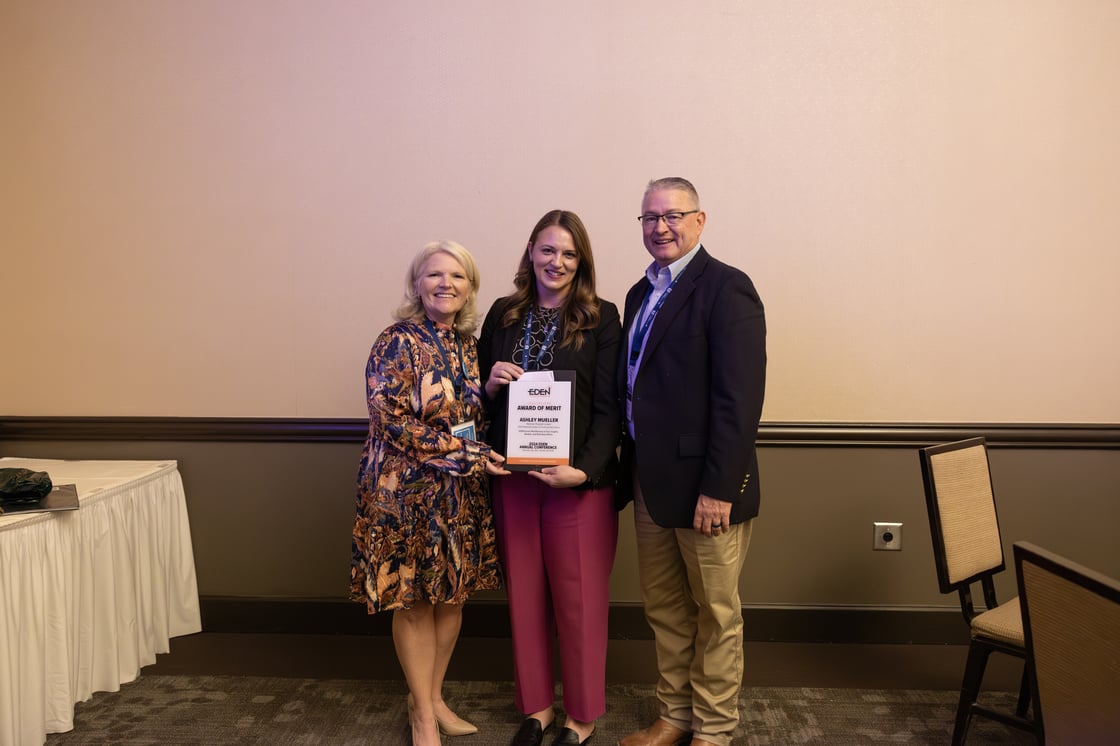
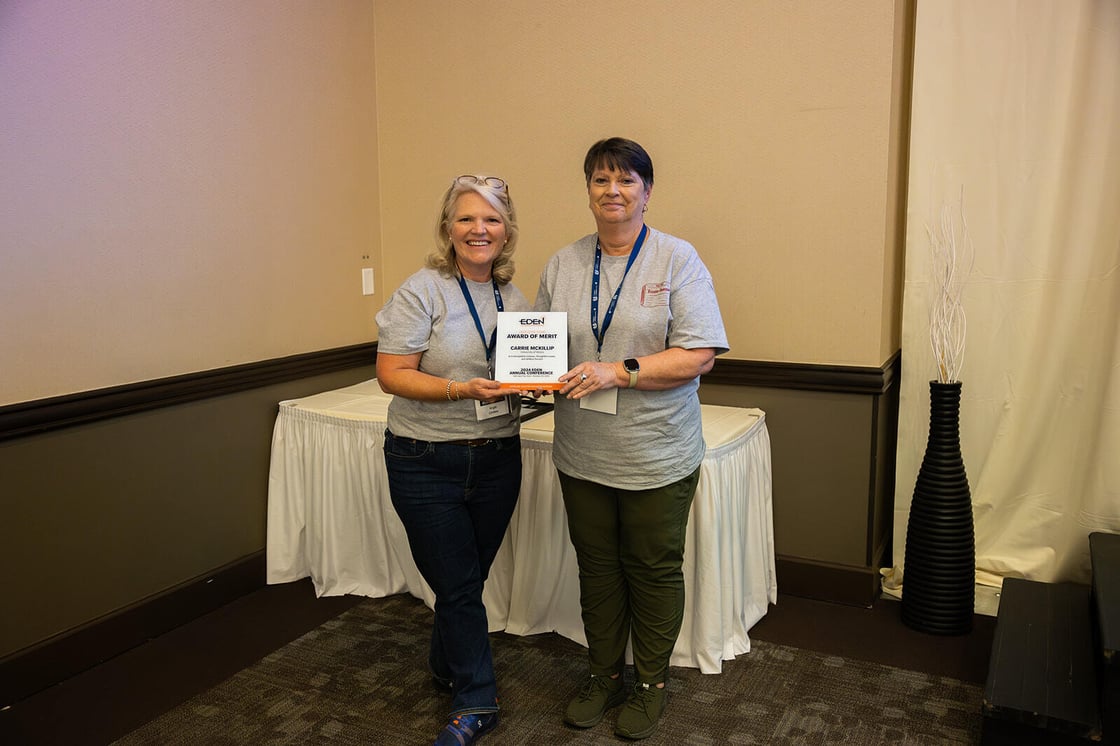
The Extension Disaster Education Network is pleased to announce the recipients of the 2024 Chair Awards, selected by immediate past-chair Tom Ball and presented at the EDEN annual conference in October. These awards recognize outstanding service, leadership, and dedication to advancing EDEN’s mission. Please join us in celebrating Ashley Mueller and Carrie McKillip’s exceptional commitment and leadership in service to EDEN and its mission.

Ashely Mueller (center) receives EDEN Chair award

Ashley Mueller

Ashley Mueller, former University of Nebraska Extension educator and current USDA NIFA Program Leader, has been a driving force in EDEN for years. From her beginnings as a University of Nebraska Extension educator to her current role, Ashley has consistently delivered innovative programming and steadfast leadership. Her contributions include:Creating impactful programs, such as the National Weather Service watch/warning education initiative and a Survivor Assistance Center curriculum in collaboration with National VOAD and Purdue Extension.Guiding EDEN through its most dynamic period of change with patience, insight, and a steady hand.Broadening EDEN’s reach and ensuring alignment with USDA NIFA’s goals while supporting new ideas for growth.We are deeply grateful for Ashley’s leadership and contributions to EDEN’s success. Congratulations, Ashley!
Carrie McKillip (right) receives EDEN Chair award

Carrie McKillip

Carrie McKillip
, Immediate Past Chair and University of Illinois Extension professional, has served EDEN in nearly every capacity: delegate, committee chair, taskforce leader, curriculum developer, and executive leader. As Chair, she provided thoughtful, visionary leadership focused on advancing EDEN’s mission while remaining committed to supporting Extension educators at the local level.Carrie’s behind-the-scenes efforts have ensured seamless operations, whether hosting the annual conference or leading network initiatives.Her legacy includes mentoring the next generation of leaders and fostering professional growth for those around her.Thank you, Carrie, for your years of service and your unwavering commitment to EDEN’s success. Congratulations!

DHS, EDEN sign memorandum of agreement to enhance disaster resilience

The Extension Disaster Education Network and U.S. Department of Homeland Security formalized their working relationship Thursday when Administrator Deanne Criswell signed a memorandum of agreement for education, mitigation, planning, preparedness, response, and recovery initiatives to help ensure equitable whole community resilience before, during, and after disasters.

EDEN Chair Angela B. Lindsey of University of Florida IFAS Extension said, “Extension is the trusted agent in so many communities across our nation.  Extension is always there with solutions based upon unbiased research and experiential learning.  EDEN and Extension touches the youngest 4-H members, small farmers and ranchers, families navigating tough economic times before, during, and after disasters, owners and operators of Main Street businesses and local industry, and even municipal, county, and state government leadership.”

She said, “When disasters happen, EDEN doesn’t have to mobilize to travel somewhere to help those hurt, injured, or at a loss to recover from the tragedy.  EDEN is already there in the county Extension offices and in the state Extension service model.  We are never outsiders coming to tell some disaster survivors what to do, EDEN is there to provide them with the plans, best practices, and tools to aid and speed their recovery and a community finding a new normal.”

EDEN Vice Chair Monty Dozier, of Texas A&M University AgriLife Extension and vice chair of EDEN, said the agreement, “Is a meaningful recognition of the efforts over the years of so many EDEN delegates and points-of-contact in emergency planning, preparedness, education, response and recovery at the county, town, community, and even the neighborhood level.  We look forward to growing even more programming and projects to bolster our community-based efforts in emergency management across the nation.”

Dr. Lindsey said she, Dr. Dozier, Secretary Faye Griffiths-Smith of University of Connecticut Extension, and the EDEN Executive Committee chairs had been working to achieve this partnership for months.  “I talked with Administrator Criswell during one of her visits to Florida following a hurricane landfall in our state earlier this year,”  Dr. Lindsey said.

She thanked Interim DHS Center Head Nicole Woods and former DHS Center head Marcus Coleman, Jr., for facilitating the partnership.

###

Hurricane Helene and Milton Resources 

Our hearts go out to everyone affected by Hurricane Helene and in the path of Hurricane Milton. We’ve compiled some fact sheets on flooding and hurricane preparedness, response, and recovery. We hope these materials – and others on the Resource Dashboard – will be valuable as you support your communities during this critical time.

Flooding resources pertaining to mental health:

Extension and Mental Health Resiliency During Time of Recovery

Flooding resources pertaining to agriculture:

Flooding resources pertaining to homes:

In addition to the flood-related resources available in our Resource Dashboard, we will continually update this page with new resources related to recovery assistance resources from our national partners.

Rapid Response to Extreme Weather Events Across Food and Agricultural Systems (NIFA)
Farm and Ranch Stress Assistance Network (NIFA)
Hurricane Recovery Assistance (USDA)
Hurricane Helene Disaster Resources (Angus Beef Bulletin)
Emergency Watershed Protection (NRCS)
Hurricane Preparation and Recovery Commodity Guides (Climate Hubs/USDA)

Resource Dashboard Submissions
We encourage you to contribute your own relevant resources to our Resource Dashboard. By sharing your knowledge and experience, you can help other Extension educators and our network become more informed.

Thank you for your ongoing support and dedication to disaster education and resilience.