New Extension resource compiles disaster education resources from 1890 land-grant institutions

KANSAS CITY, Mo. – Extension personnel at the Southern University Agricultural Research and Extension Center, SUAREC, recently launched a new resource titled “Advancing Disaster Education: 1890 Research-Based Curriculums, Lessons and Workshops.” The project compiles educational modules, workshop agendas, and a collection of relevant fact sheets related to disaster education from 1890 land-grant institutions. 

The publication, made possible by an Extension Disaster Education Network Development Grant and published by the Extension Foundation, features contributions from project authors Krystle J. Allen, Angell C. Jordan, Marlin R. Ford, and Kiyana E. Kelly. This comprehensive 94-page resource serves as a centralized hub of essential information, empowering educators and communities to enhance their resilience against disasters through a single, comprehensive document.

The resource caters to a variety of demographics, including homeless individuals, low-income groups, farmers, youth, families, older adults, and pets, with a specific focus on rural and low-resource regions. Underserved communities are often less likely to engage in preparedness efforts, and this publication serves as a valuable asset for Cooperative Extension offices and programs seeking to support these communities.

“Preparedness saves lives,” said lead author Krystle J. Allen, SUAREC Family and Human Science program leader and Community and Economic Development assistant specialist. “We have to collaborate with some of our most underserved populations to strengthen their resilience.”

This compilation offers a range of adaptable materials for extension professionals and K-12 educators.

Noel M. Estwick, chair of the 1890 EDEN project, expressed confidence in the resource’s potential impact, stating, “I believe this publication will be a significant addition to the national EDEN shared resources, contributing to disaster resilience, emergency preparedness, response, and management efforts both domestically and internationally.”

The “Advancing Disaster Education” resource is now accessible on the EDEN Resource Dashboard, providing a wide array of adaptable materials aimed at strengthening disaster preparedness and response efforts across the country. Learn more and access the resource at https://extensiondisaster.net/resource-dashboard/1890-curriculum/

###

1890-EDEN Advisory Group attend summer meeting

Cooperative Extension professionals from 1890 Land-grant Universities gathered at the campus of North Carolina Agricultural and Technical State University (N.C. A&T) to plan for natural and man-made disasters during the 1890 Extension Disaster Education Network (EDEN) Advisory Group (AG) 2024 face-to-face workshop and business meeting.

The three-day annual meeting took place June 4-6 in Greensboro, North Carolina. Six 1890 universities were represented with attendees from Fort Valley State University (FVSU), Southern University Ag Center (SU), Tennessee State University (TSU), Prairie View A&M University (PVAMU), the University of Arkansas at Pine Bluff (UAPB) and N.C. A&T.

Additional EDEN delegates in attendance included representatives from Washington State University (WSU), University of Illinois (U of I) the University of the Virgin Islands (UVI), University of Florida Institute of Food and Agricultural Sciences (UF/IFAS) and the Southern Sustainable Agriculture Research and Education (SARE) program.

During the three-day training, participants focused on building community and cultural competency in disaster education. Dr. Ray McKinnie, associate dean and administrator for Cooperative Extension at N.C. A&T gave opening remarks to attendees and welcomed them to campus. In addition, Dr. Alton Thompson, executive director for the Association of 1890 Research Directors (ARD), and Dr. Albert Essel, executive director for the Association of Extension Administrators (AEA) expressed appreciation for the work of the 1890-EDEN AG. Each offered their perspective for why it is critically essential for 1890 Land-grant professionals to provide research-based information and services to communities and citizen groups impacted by disasters.

Dr. Noel M. Estwick, assistant professor and research scientist at PVAMU, said his role in the AG started in 2017. Over the years he has used his training as an urban planner to support the land-grant mission by offering disaster-related support to the research, education and outreach initiatives of the College of Agriculture, Food and Natural Resources.

“I got involved in EDEN as the principal investigator for the 1890-EDEN Project. In 2017, the advisory group was created with the support of the 1890 Extension administrators,” Estwick said.

He said the face-to-face meeting in Greensboro marked the seventh year the group has been in existence. The Prairie View researcher said the meeting was helpful for several reasons.

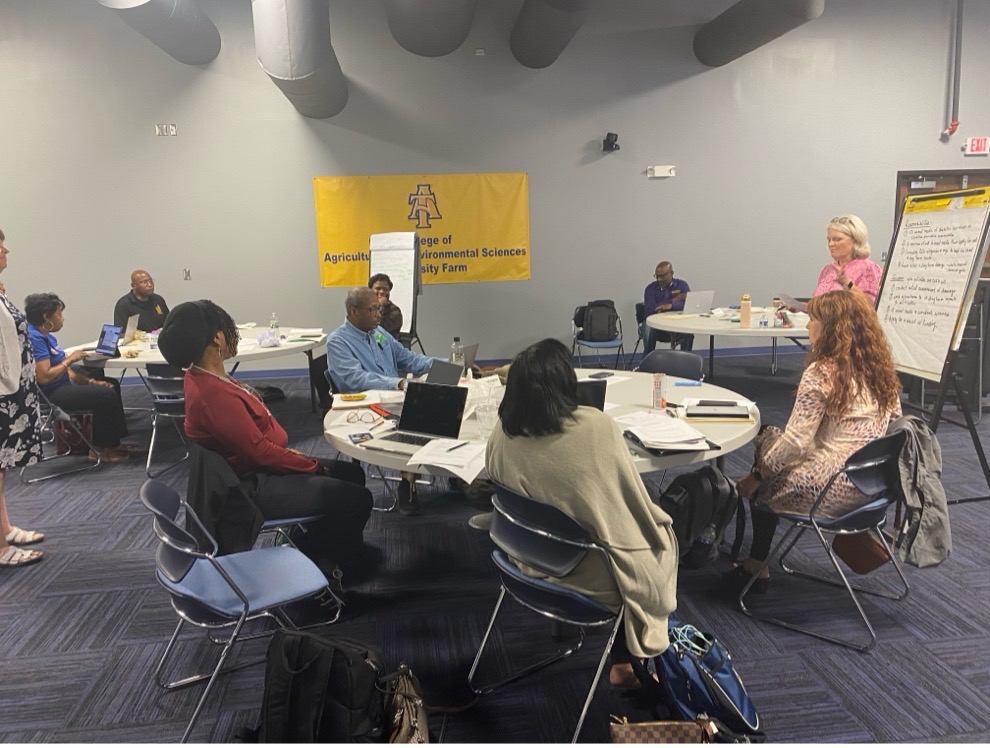
“It provided opportunities for the advisory group to review current collaborations, projects and progress, while providing training to boost our capacity to deliver disaster programming,” Estwick said. Carrie McKillip, past EDEN chair and community and economic development educator at U of I Extension, conducted a training on Community Organizations Active in Disasters (COAD) Development and Maintenance.

Members of the 1890 EDEN AG and EDEN delegates participated in a training session on COAD Development and Maintenance during their three-day workshop.
Members of the 1890 EDEN AG and EDEN delegates participated in a training session on COAD Development and Maintenance Members of the 1890 EDEN AG and EDEN delegates participated in a training session on COAD Development and Maintenance during their three-day workshop.during their three-day workshop.

He also said the annual face-to-face meeting helps him and attendees become better at serving limited-resource audiences. Likewise, the meeting creates an environment to develop consistent institutional partnerships with land-grant universities and federal and nonfederal partners.

One of those opportunities occurred during the Greensboro meeting with the participation of Vanessa Forbes, Extension agent and SARE program assistant for the UVI.

“Her participation enabled us to learn from each other as we discussed challenges and lessons learned from serving similar clientele in unique settings,” Estwick said.

Forbes said the UVI Extension became involved with EDEN because of the gaps in information and awareness within the U.S. Virgin Islands.

“In an attempt to bridge the gaps between the diverse cultures of the Virgin Islands, the groundwork and connections need to be in place in advance of a disaster so that when there is a disaster, the education and the services needed will be set in place to facilitate the duties necessary to bring about recovery,” Forbes said.

Furthermore, Forbes shared how she hopes being connected to the 1890-EDEN AG will be able to work as a bridge.

“This will allow us to overcome the predominant separation and develop a sense of oneness in education and mitigation regarding disasters. Through this education, a greater strength will be recognized,” Forbes said.

In addition to training, the AG group institutions partner to respond to requests for proposals. AG institutions are currently partnering on two funded projects. The first is a SARE professional development program called, “Developing a Training Program on Surviving Disasters through Risk Management Preparation and Best Management Practices for Agricultural Producers.” N.C. A&T is leading the project.

The second project is an EDEN capacity grant led by SU Ag Center. It is called “Cultivating an Efficient and Productive Intersection between Research and Extension: An 1890 Collaborative-Research Based Curriculum Development Initiative.”

For more information about the 1890-EDEN AG, visit https://extensiondisaster.net.   

Extension Education Disaster Network Celebrates Awardees of EDEN Development Grants

KANSAS CITY, Mo. – The Extension Disaster Education Network (EDEN) is pleased to announce the recipients of its 2024 Development Grants. These grants support innovative projects that strengthen disaster preparedness, response, and recovery efforts across the nation.

The grant recipients and programs for this cycle are:

  • Utah State University: Led by Stephanie Carlson, hosting the 2024 EDEN Conference to bring together disaster preparedness experts and practitioners.
  • University of Nebraska: Led by Cindy Brison, developing an Emergency Preparedness Train-the-Trainer Project to increase the capacity of Extension professionals to deliver disaster education.
  • University of Kentucky: Led by Andrea Higdon, launching a project titled “Get Out of Your Exercise Rut! Using Games to Bring Extension and Emergency Management Together to Prepare Communities for Disasters.”
  • University of Kentucky: Led by Jeffrey Young, supporting the development of a Kentucky Extension Strike Team to provide rapid response to disaster-affected areas.
  • University of Wyoming: Led by Jennifer Thompson, Rebooting Wyoming’s Disaster Education Efforts to rebuild and enhance the state’s disaster preparedness programs.

“These projects exemplify the commitment of the land-grant system to addressing needs and building resilient communities across the nation,” said Fred Schlutt, EDEN Project Manager. “We are excited to see the impact of these innovative approaches to disaster preparedness, response, and recovery.”

EDEN Development Grants, ranging from $5,000 to $15,000, aim to encourage collaboration and invest in innovative educational resources and disaster-related Extension initiatives at land-grant and sea-grant systems nationwide. The program is structured around four focus areas: production of publicly available EDEN resources and scholarship, professional development of EDEN Points of Contact and Delegates, enhanced membership and participation efforts, and enhancement of partnerships and networks on behalf of EDEN. The next grant period is anticipated to open September 3.

For inquiries about the EDEN Development Grants Program, please email Fred Schlutt at fredschlutt@extension.org. To apply and learn more about the application process or the next application cycle, visit the EDEN website here.

###

Media Contact:
Ruth Inman
EDEN Marketing and Outreach Coordinator
ruthinman@extension.org
405-612-7639

Request for application and application guide for EDEN Grants

REQUEST FOR APPLICATIONS & APPLICATION GUIDE

ADVANCING DISASTER EDUCATION IN AMERICA 

Download RFA HERE

ELIGIBILITY: Applications may be submitted by Extension professionals employed by land-grant or sea-grant universities that are members of the Extension Disaster Education Network (EDEN). For committee-specific awards, at least one individual named in the proposed project must be a committee member. For the larger awards, at least one individual on any proposed project must be an EDEN delegate or Point of Contact.


AWARD AMOUNT: Up to nine $5,000 grants are available to all nine eligible EDEN committees, AND Four $10,000 grants AND one $15,000 grant are intended to foster cross-committee/cross-topic engagement 


TIMELINE:

  • Application Open: April 1, 2024
  • Application Deadline: 11:59 pm Pacific on Friday, May 10, 2024
  • Award Notification: May 2024
  • Award Period: June 1, 2024 – December 31, 2024

The purpose of the Extension Disaster Education Network (EDEN) Development Grants Program (“Mini-Grants”) is to invest in the development of innovative educational resources and Extension initiatives that can advance the work of EDEN and support the broader land-grant and sea-grant systems across the nation in addressing the preparation for, response to, and recovery from hazards and disasters. Four mini-grant focus areas have been developed from EDEN’s Strategic Planning process led by the EDEN Executive Committee. This document outlines 1) The types and amounts of mini-grants available, 2) The process(es) for applying for each of those types of mini-grants, and 3) The review, award, and monitoring processes. 

FOCUS AREAS: The EDEN mini-grant process is designed to generate activities and work products that contribute directly to the success of EDEN as an organization. Proposals must address one of the following broad areas of focus: 

  1. Production of publicly available EDEN resources and scholarship. Deliverables must increase the scope, variety, and number of disaster-related materials available on the website.
  2. Professional Development of EDEN POCs and Delegates. Deliverables must include training, EDEN certificates, and related projects to enhance the personal and professional capacity of EDEN Delegates. 
  3. Enhanced membership and participation. Deliverables must include efforts and activities to generate new institutional memberships, increase delegate numbers, and increase participation, particularly among underrepresented groups such as 1890 and 1994 institutions. 
  4. Enhancement of partnerships, relationships, and networks on behalf of EDEN. Deliverables would include outreach and engagement activities intended to build new funding relationships with agencies and organizations, including, but not limited to, USDA. 

GRANT TYPES: The mini-grant program comprises cost-reimbursement, noncompetitive, and competitive grants at three different funding levels. 

  1. $5,000 – Committee Project: One award of up to $5,000 will be made available to each of the nine eligible EDEN committees. The purpose of each of these noncompetitive awards will be for a committee-specific project that supports one of the four focus areas described above. These are the EDEN committees eligible to apply: 
    1. Agriculture 
    2. Natural Resources 
    3. Professional Development 
    4. Community & Economic Development 
    5. 4-H Youth Development 
    6. Exercise & Training for Disaster Resilience 
    7. Family & Consumer Sciences 
    8. Marketing & Membership 
    9. Annual Conference
  2. $10,000 – EDEN Focus Area: Four competitive $10,000 grants—one per focus area outlined above. Deliverables must include activities, outcomes, impacts, and materials specific to the topic area of focus.
  3. $15,000 – EDEN Cross-Committee/Cross-Focus Area Engagement: One competitive $15,000 grant intended to foster cross-committee/cross-focus area engagement. Deliverables must address cross-committee activities and EDEN-wide benefits.


WHERE TO APPLY

Applications should be filled out through the FADI-EDEN Application Portal provided by Extension Foundation: https://webportalapp.com/sp/eden. For additional information, questions, or clarifications, email brennakotar@extension.org. For a walk-through of how to set up your account in the FADI-EDEN Application Portal and how to submit your application, click here

If you have questions about any EDEN Development Grants Program aspect, please contact Fred Schlutt at fredschlutt@extension.org.


BUDGET AND BUDGET CONSIDERATIONS

The budget should address each of the major cost categories outlined in the Federal SF-424 Research and Related Budget form (see brief outline below).  No match of institutional funds is required. NIFA Federal Assistance Policy Guide (https://nifa.usda.gov/resource/nifa-federal-assistance-policy-guide).


  • Personnel Costs (R&R Sections A&B)
    • Compensation in the form of Salaries and Wages for the faculty, technicians, research associates and assistants, postdoctoral associates, and other technical personnel necessary to meet the project’s goals, computed as either percent effort, hourly wages, or person-months.
    • Fringe Benefits typically encompass employer contributions for social security, employee life, health, unemployment, worker’s compensation insurance, and pension plan costs related to the personnel charged to the project. Costs must be expressed as a percentage of salaries and wages in the proposal budget based on negotiated Federal rates applicable to each person or role.
  • Equipment Costs: Capital equipment (R&R Section C) is defined as tangible personal property (including information technology systems) having a useful life of more than one year and an acquisition cost of $5,000 or more per unit. Total unit cost per item includes the cost of the item, sales tax, and shipping. Requests must include item description, justification of use for equipment on the project, quote to substantiate the equipment cost, and plan for equipment disposal at the end of the performance period. Agency approval must be obtained before awarded funds may be released. Equipment is considered noncapital if both cost and useful life criteria are unmet (see Other Direct Costs below).
  • Travel Costs (R&R Section D): Employee transportation, lodging, and subsistence costs that directly support the project’s aims. In the budget justification, include the destination, number of people traveling, and dates or duration of each stay for all anticipated travel.
  • Participant Support Costs (R&R Section E): Direct costs for items such as stipends or honoraria, subsistence allowances, travel allowances, and registration fees paid to or on behalf of participants or trainees (but not employees) in connection with conferences or training projects. NIFA considers payments to non-participants, e.g., organizers, recruiters, influencers, trainers, coaches, etc., who encourage or assist participants to be Participant Support. Payments made to defray the cost of participation, e.g., for travel and meals, are also allowed in accordance with institutional policies and documentation requirements.
  • Other Direct Costs (R&R Section F):
    • Materials and Supplies: Consumables to be used in the performance of the proposed project, e.g., laboratory items and data processing supplies.
    • Non-Capital Equipment: Equipment that does not meet both capitalization criteria above. Note that such items are indistinguishable from other supplies.
    • Consultants/Independent Contractors: Consultants who provide expertise or service to a particular project consistent with their normal course of business.
    • Subawards: A contract specifically creating a Federal assistance relationship with a subrecipient to carry out part of a Federal award received by the project applicant. A subrecipient is typically assigned responsibility for programmatic decision-making, and subsequent performance is measured concerning whether assigned project objectives were met.
    • Tuition Remission: Mandatory benefit for students employed as Graduate Research Assistants/Associates (GRAs) that is separate and distinct from other employee fringe benefits.
    • Other Costs: Various items such as vendor contracts for ancillary goods and services, publication, and meeting costs. It also may include items that are normally indirect, e.g., telephone long distance and photocopy costs, that are directly related and assignable with a high degree of accuracy.
  • Indirect costs (R&R Section H): Whereas Direct Costs (R&R Sections A-F) can be identified specifically with the performance of a project, Indirect (aka Facilities and Administrative) Costs are incurred for common or joint objectives and, therefore, cannot be identified readily and specifically with any project. Indirect Costs are quantified as a percentage of a predefined Direct Cost base: Total Direct Costs (TDC), Modified Total Direct Costs (MTDC), or Salaries and Wages (S&W) that may or may not include Fringe Benefits. Note that Indirect Cost rates remain unchanged for the life of the project. Applicants will be allowed a maximum of a 10% indirect cost rate in their budget.


REPORTING

Each project will be required to provide monthly check-in updates and submit a progress report mid-funding cycle (August, 2024) and a final programmatic report within 30 days of the end date of the award period (January 30, 2025). The report will outline the project and describe its outcomes/impact. It will be submitted through the FADI-EDEN Application Portal.

Each project will be required to submit a quarterly financial report due within 30 days of the end of the quarter and a final financial report due within 60 days of the end of the award period. 


AWARD REVIEW PROCESS

The EDEN Development Grants Program takes seriously the need for a sound and unbiased peer-review process for all proposals submitted.  Review panels will evaluate each award type and convene to identify funding selections.  

Proposals will be evaluated on the following criteria: 

  • The proposed project’s merit and its intended impact on the Extension community.
  • The proposed project’s relevance in addressing one or more of the Critical Focus Areas. 
  • The soundness of the methodology being proposed.
  • The project’s potential contribution to the research literature is to inform policy discussions at federal, regional, state, and/or local levels and/or to improve food assistance/nutrition-related program outreach/delivery activities. 
  • The qualifications of the individual or team that will provide leadership to the research effort. 


APPLICATION FORM FIELDS

The application form fields are meant to provide guidance for the opportunity and the resources available to frame your proposal. Although the individual questions are listed below, with space available to craft your responses, the proposal must be submitted using the FADI-EDEN Application Portal at https://webportalapp.com/sp/eden

Monthly Newsletter: August 2023

Monthly Newsletter: June 2023

2023 EDEN Annual Conference Registration Now Open!

Registration for the 2023 EDEN Annual Conference is now open! Once a year, EDEN delegates assemble at the EDEN Annual Conference to share best practices, developing research, showcase projects that have been completed throughout the year, and enhance skill sets through professional development opportunities. The conference will offer guest speakers, breakout sessions, educational excursions, networking opportunities and a professional development training. This year, we are excited to be hosted by the University of Georgia in Savannah, Georgia, from September 26th-29th.

To view the agenda, find hotel information, register for the conference or learn more details, visit EDEN’s Annual Conference webpage at https://extensiondisaster.net/news-events/annual-meeting/. For questions, please contact Amanda Mosiman, Purdue FADI/EDEN Support Team, at bailey1@purdue.edu or Michael Martin, Annual Conference Committee Chair, at michael.martin@uga.edu

From the Chair

While Extension Disaster Education Network member-institution resources were busy of late dealing with smoke from Canadian wildfires that blanketed the Midwest and East occupied much of the national news; EDEN points of contact and delegates in the South have been dealing with almost every sort of natural disaster. From bouts of flash flooding caused by hail, tornado activity, thunderstorms, and torrential rains in Texas, Oklahoma, Louisiana, Mississippi, Alabama, and Arkansas, to the almost unceasing severe weather events in Florida and Georgia; EDEN educators and strike team members have been busy assisting with agricultural damage assessment, livestock loss and emergency care, individual assistance, donations management, sheltering, unusually large numbers of utility disruption, and impacts of flash flooding. We thank all of those involved in helping their constituents, business, industry, governmental partners, and citizens in dealing with the impacts of these most unusual weather patterns.

This type of weather situation helps focus attention to the activities of the new EDEN Natural Resources committee, which is currently searching for a vice chair to assist chair Josh Gunn, of Michigan State University Extension, in establishing programmatic goals and objectives for the group for the coming year. EDEN officers and Executive Committee members want to remind you that our website has multiple opportunities for collecting and sharing vital information to help stakeholders, clients, and citizens during times of emergency. Officers also want you to know that our contact information is available for consultation or resource allocation, if and when needed and requested through established emergency management channels. In other news, Tommy Bass, EDEN Agriculture Committee chair since 2022, has recently been named to a seat on the United States Department of Agriculture Food and Agriculture Coordinating Council. (See below for more details.)

Also of interest to EDEN points-of-contact and delegates may be that USDA National Institute of Food and Agriculture is in the process of determining the new collaborating/host institution for EDEN. Purdue University Food and Agriculture Defense Initiative team will no longer be the logistical base of EDEN. Purdue University officials, with Dr. Jason Henderson’s departure to Iowa State University Extension and Outreach and a new dean of the Purdue University College of Agriculture being named, decided not to apply for another four-year term as the foundational/logistical support of EDEN. It is thought that USDA NIFA received about a handful of submissions from institutions and organizations seeking the opportunity to host EDEN and the FADI program in the coming years. We look forward to an announcement from USDA NIFA and Program Leader Ashley Mueller in the near future to inform us of our new home and are excited about the possibilities of becoming a more vibrant, impactful, and recognizable part of nationwide Extension.

Please remember to join and attend your committee meetings, webinars by any EDEN committee, and if you are a point of contact upcoming POC Zoom meetings.

Thank you for what you have done for your member institutions and for EDEN.

Tom Ball

Chair, Extension Disaster Education Network

Wildfire & Air Quality Resources

According to the National Interagency Fire Center, there has been 21,305 wildfires that have have burned 644,918 acres across the United States since January 1, 2023 and since May 8, the U.S. has mobilized a total of 823 personnel via the CIFFC/National Interagency Fire Center agreement to Alberta, British Columbia, Ontario, Quebec.

With all of the recent wildfires and smoke pollution, EDEN has been seeking resources for wildfires and smoke damage. EDEN delegates have submitted over a dozen new resources to support wildfire awareness, prevention and recovery, ranging from websites such as AirNow.gov, which offers educational resources for youth and adults, to home emergency management guides. View these resources here, or submit your own wildfire and smoke resources for EDEN here.

EDEN Committee Chair Named to USDA Food and Agriculture Coordinating Council

Tommy Bass, EDEN Agriculture Committee chair since 2022, has recently been named to a seat on the United States Department of Agriculture Food and Agriculture Coordinating Council.  The council monitors policy activities of USDA and submits best practices and possible policy to the department. He serves with two dozen others representing livestock and animal health, producer, grower, and farm organizations, business and industry, state government, land-grant institutions, state regulators, and homeland security. Tommy is a EDEN longtime point of contact from Montana State University and has led the Agriculture Committee with distinction. Best wishes and congratulations to Tommy!

Committee Meeting Zoom Updates

Starting the week of June 26th, there will be new Zoom links for all committee meetings. Claire Crum, EDEN’s Communications Coordinator, has accepted a new role as a 4-H Extension Educator in Cass County, IN. Therefore, all current committee meeting links will be removed and replaced with new links, made by the committee chairs. Please keep an eye out for new Zoom links for Committee meetings, and reach out to your committee chair with any issues. All committee links will be posted to the website event calendar as well.

New Agriculture Committee Vice Chair

The EDEN Agriculture Committee is excited to introduce the newly elected Vice Chair, Samantha Gehrett. Samantha is a dairy educator based in Cumberland County Pennsylvania. She joined Extension after working at Pennsylvania Farm Bureau as the Director of Training in the Member Services Division; Samantha developed and implemented trainings for new staff and current staff members. She serviced clients throughout the Agricultural Sector, for whom she was responsible for providing professional services to meet their financial and business needs. Additionally, she worked as a Supervisor for a Grade A milk processing facility in Wisconsin. She received her Bachelor’s Degree in Agricultural Sciences from Penn State in addition to two minors in Environmental Inquiry and Agronomy. She has her Master’s Degree from Penn State in Homeland Security with a focus on Agricultural Biosecurity and Food Safety Defense.

EDEN POC Meeting in July: Learn more about POC Responsibilities

Points of Contact will have a Zoom meeting on Tuesday, July 25th from 3:00-4:00pm (EST). All POCs should attend to discuss responsibilities, best practices, and future plans for POCs. The Zoom invite will be sent to all POCs via the POC listserv. Please contact Claire Crum with questions, or to be added to the POC listserv, if you are not already.

Monthly Newsletter: May 2023

Annual Conference Registration to Open Soon

The 2023 EDEN Annual Conference Registration will be open soon! Check the website for newly shared meeting rates and hotel information. Registration for the conference will open soon on the EDEN Annual Conference website.

Upcoming Monthly Webinar

EDEN’s monthly webinar for May 2023 is scheduled for Wednesday, May 31st at 1:00pm (EST). The webinar, “Digital Equity & Disaster Education” will be presented by EDEN delegate Cheyanne Geideman, EDEN’s CED Committee Chair. Register for the webinar here.

EDEN COAD Manual

The 2023 EDEN COAD manual explores how Extension professionals can use COADs (Community Organizations Active in Disaster) and community forums to reduce the impact of disasters and build a more efficient response and recovery process. This manual provides instructions, worksheets, tools, and advice for creating, maintaining, and sustaining COADs in communities. This manual will be of value to Cooperative Extension professionals and other organizations and institutions considering ways to increase community buy-in to address disaster issues together.

The authors of this manual are Extension professionals serving as EDEN delegates, and have dedicated years to developing COADs in their communities, throughout their states, and nationwide. The manual was written by a team from the University of Illinois Extension, Purdue Extension, University of Nebraska Extension, and University of Missouri.

EDEN POC Meeting in July: Learn more about POC Responsibilities

Points of Contact will have a Zoom meeting on Tuesday, July 25th from 3:00-4:00pm (EST). All POCs should attend to discuss responsibilities, best practices, and future plans for POCs. The Zoom invite will be sent to all POCs via the POC listserv. Please contact Claire Crum with questions, or to be added to the POC listserv, if you are not already.
EDEN Chair Elect Earns Hurricane Hero Award

Angie Lindsey, the Point of Contact for the University of Florida and EDEN’s Chair Elect was recently awarded the Hurricane Hero award from the Florida Veterinary Medical Association for her hard work before, during, and after Hurricane Ian. Learn more about Dr. Lindsey and her hurricane response efforts here.

New in 2023: EDEN COAD Manual

This manual explores how Extension professionals can use COADs (Community Organizations Active in Disaster (COADs) and community forums to reduce the impact of disasters and build a more efficient response and recovery process. This manual provides instructions, worksheets, tools, and advice for creating, maintaining, and sustaining COADs in communities. This manual will be of value to Cooperative Extension professionals and other organizations and institutions considering ways to increase community buy-in to address disaster issues together.

The authors of this manual are Extension professionals serving as EDEN delegates, and have dedicated years to developing COADs in their communities, throughout their states, and nationwide. The manual was written by a team from the University of Illinois Extension, Purdue Extension, University of Nebraska Extension, and University of Missouri. This project was supported with funding from the Extension Disaster Education Network (EDEN) using Food and Agriculture Defense Initiative (FADI) funding from the National Institute of Food and Agriculture, U.S. Department of Agriculture under NIFA/USDA Agreement No. 2018-37620-28830.

View the COAD Manual Here

Monthly Newsletter: April 2023

Call for Proposals for EDEN Annual Conference- Submit Now!

The 2023 EDEN Annual Conference Committee invites EDEN Delegates, Points-of-Contact, Extension Professionals, and Researchers to submit an abstract to be considered for presentation at the Extension Disaster Education Network Conference, September 26th-29th, 2023 in Savannah, GA. Please share the call for proposals with eligible colleagues and professional groups that may be interested. To learn more, visit the link: https://extensiondisaster.net/eden-annual-conference-2023-call-for-presentation-and-poster-proposals/

Deadline for submission: April 28, 2023, at 5pm ET


EDEN Development Grant Supports Large Animal Rescue Training for AgriLife Extension Agents

(Photo by Nathanael Van Soest, Texas A&M AgriLife.)

Texas A&M AgriLife Extension Service Disaster Assessment and Recovery, DAR, had the opportunity to attend a two-day training to learn how to “safely recover, rescue horses and other large animals with techniques and strategies” taught by the Texas A&M Engineering Extension Service, TEEX, Emergency Services Training Institute.

The training exercise completion is part of a National Extension Disaster Education Network grant, funded by the U.S. Department of Agriculture-National Institute of Food and Agriculture Food and Agriculture Defense Initiative.

Monty Dozier, Associate Professor and Extension Program Director at Texas A&M and our current EDEN secretary, coordinated the training. “These exercises demonstrate how can we help those first responders with our expertise in working with animals and understanding dynamics of large animals so we can help that recovery process,” Dozier said.

The training was recently featured in the NIFA in the News weekly update. Read more about the training here.

Important EDEN Directory Update

The Extension Disaster Education Network is updating the website directory. In recent years, many EDEN delegates have retired, taken on new roles, joined a committee or updated their contact information. To encourage efficient networking, these changes need to be corrected within the website directory.

All EDEN Points of Contact are asked to reach out to the delegates at their institution and confirm their contact information. POCs should reach out to their delegates as soon as possible and report any changes to be made to Claire Crum, EDEN’s Communications Coordinator at crumc@purdue.edu.

If you are a delegate and need to make changes to your delegate profile, such as listing you as a member of a committee or updating an email address, please contact your POC. All POCs and delegates can be found in the EDEN Directory.

Anyone who is interested in joining an EDEN standing committee should reach out to crumc@purdue.edu to be added to the committee listserv, where you will receive committee notes, updates and training opportunities!

2023 EDEN Development Grant- Available Now!

The purpose of the Extension Disaster Education Network (EDEN) Development Grants Program is to invest in the development of innovative educational resources and Extension initiatives that can advance the work of EDEN and the broader land-grant and sea-grant systems across the nation in addressing the preparation for, response to, and recovery from hazards and disasters. Five Critical Focus Areas (CFAs) emerged from EDEN’s Strategic Planning process led by the EDEN Executive Committee. This document outlines the key information for applicants planning to submit grant proposals to address one of the five CFAs. Proposals will support the development of collaborative teams to conduct applied research to evaluate existing resources, identify gaps in programming, facilitate the develop of, certification methods for, and the regionally-based delivery of training to enhance the capability of Extension professionals in the critical areas. The primary outcome would be a white paper that would identify current gaps and future directions, opportunities, and challenges to addressing the CFAs.

The maximum amount allowed for any single EDEN grant proposal is $20,000. Applicants will be allowed a 10 percent indirect cost rate in their budget. However, the total amount may not exceed the $20,000 allocation. In addition, award recipients would also be provided graphic design and editing support to complete their final report.

The deadline for submission is 11:59 p.m. Pacific Time, May 1, 2023.

View the RFP Here 

EDEN Strategic Plan

On February 28-29, the EDEN executive team met in Orlando, Florida, for the mid-winter meeting. Staff from the UF/IFAS Center for Public Issues Education (PIE Center) helped the executive team determine action items as part of EDEN’s new strategic plan. Leading up to the meeting, PIE Center staff conducted listening sessions with EDEN stakeholders to guide the development of its strategic plan. The final report and strategic plan were introduced to EDEN members during the annual conference in October 2022. At the mid-winter meeting, the EDEN executive team delved further into the strategic plan to discuss how each committee could implement different areas. The PIE Center led the group in brainstorming activities to identify specific objectives and tasks within the strategic plan focus areas, which were established by stakeholders during the data-gathering process. Since the meeting, executive committee members have been working to move the needle forward on initiatives within the strategic plan. View the strategic plan here: https://extensiondisaster.net/about/important-documents/ 


Funding Opportunity: Food and Agriculture Defense Initiative Extension Disaster Education Network

 (FADI-EDEN) Program

Application deadline: May 11, 2023, at 5:00 pm ET

The goal of the FADI-EDEN program is to maximize the resilience of the U.S. food and agriculture sector to biosecurity risks, extreme weather events and disasters, cyber threats, and other shocks. The FADI-EDEN program will fund one Extension project that will address its priorities.

RFA and applicant resources are available at: https://www.nifa.usda.gov/grants/funding-opportunities/food-agriculture-defense-initiative-extension-disaster-education-0

Call for Content for the New EDEN Monthly Impact Report

EDEN’s new Monthly Impact Report seeks to spotlight EDEN’s successful programs and the impact they have had, as well as the potential impact of new and upcoming programs.

A call for content is sent monthly to all EDEN delegates. Please send any content to be shared in the report to EDEN’s Communication Coordinator, Claire Crum, at crumc@purdue.edu.

EDEN Annual Conference 2023 Call for Presentation and Poster Proposals

Call for Presentation and Poster Proposals

The 2023 EDEN Annual Conference Committee invites EDEN Delegates,Points-of-Contact, Extension Professionals, and Researchers to submit an abstract to be considered for presentation at the Extension Disaster Education Network Conference, September 26th-29th, 2023 in Savannah, GA. Please share the call for proposals with eligible colleagues and professional groups that may be interested.SUBMIT PROPOSAL NOW

Deadline for submission: April 28, 2023, at 5pm ET

To be selected, it is crucial that submissions be compelling in both the importance of the subject matter and show experience and in-depth knowledge of the subject.

Presentations in the following areas will be considered:

  • Current issues in disaster education with a special interest in different approaches used by Cooperative Extension Systems (CES) and associated programs, partners (Sea Grant), and traditionally underserved and lower socioeconomic communities
  • Current research and practice in disaster education and disaster preparedness, mitigation, response, recovery, and Whole Community Resilience
  • Successful internal and externals partnerships practices
  • Innovative curriculum, programs, or projects, including USDA NIFA funded projects
  • Emerging issues in disaster education and disaster management that may have implications for CES and affiliated partners
  • Research projects of an applied nature and that contribute to extension and outreach on disaster education
  • Research that addresses systematic response and recovery systems of disaster and lessons learned


Sessions are forty-five (45) minutes in length, with 35 minutes for presentation and 10 minutes for audience questions.

Program and poster presenters must register for the meeting at their own expense. No honorariums will be provided. It is the intention of the Annual Meeting Committee to offer registration options for an in-person conference only in 2023. Presenters will be expected to attend in person if their university allows for travel in September. 

Please share the call for proposals with colleagues and professional groups that may be interested.

General Program and Poster Presenter Information

Individuals selected to present a program or poster presentation are expected to submit their final presentation and materials (i.e. handouts or worksheets) to EDEN for posting with the annual conference proceedings on the EDEN website.

Poster dimensions will be sent to those posters that are accepted. The EDEN Annual Conference Committee is responsible for the printing of the posters, not the presenter. Please note that posters WILL BE printed and taken to the conference. Therefore, FINAL poster files will need to be submitted before September 1, 2023.

Posters will be prominently displayed, and researchers/authors will have a chance to present as conference schedule allows. The primary presenter and/or a co-author are expected to attend and deliver the presentation in person.

Posters may be used to provide an update to a project or program previously presented at an EDEN Annual Conference.

Evaluation Criteria for Program Presentations

The following criteria will be used to evaluate program presentation proposals:

  • Overall quality.
  • Ability to attract an audience across program disciplines.
  • Scope of coverage — Does the program or content have applications or implications across a relatively large geographic location?
  • Is program evaluation information presented?
  • Can “methods” employed be adapted to other content or subject matter?
  • Application–Will content help EDEN and other Extension professionals do their work more effectively or provide a research context for building future educational programs and materials?
  • Originality –Has the individual presented on this topic at a previous EDEN meeting? If so, has the material changed enough to be new and/or beneficial to the audience?

A computer and digital projector will be provided for each presentation.

Evaluation Criteria for Poster Presentations

The following criteria will be used to evaluate poster presentation proposals:


  • Scope of coverage – Does the program focus on disaster research or education programming?
  • Does the program or content have applications or implications across a relatively large geographic location?
  • Is program evaluation information presented?
  • Can methods employed be adapted to other content or subject matter?
  • Application–Will content help EDEN and other Extension professionals do their work more effectively?


Submission Deadline: April 28, 2023, 5:00 p.m. Eastern Standard Time


Presenters to be notified by May 26, 2023, 5:00 p.m. Eastern Standard Time


Submission

Proposals must be submitted electronically using the online submission form.
Abstract Submission Form

Submission Deadline: April 28, 2023, at 5pm ET
Presenters to be notified by May 26, 2022


You will be asked to provide the following when submitting the form:

  • Primary Presenter Information: first and last name, institution, primary contact phone number and email address
  • Co-Presenter(s): name and institution
  • Bio and Picture(s) for Presenter(s): To be used in the program and for the introduction of speakers
  • Title of presentation
  • Presentation type – program, poster or both
    • If abstract is not chosen for a presentation, it may be chosen as a poster
  • Program area(s): 4-H Youth Development, Agriculture, Natural Resources, Community Disaster Readiness and Exercise, Communications, Community Development, Family Consumer Sciences, Sea Grant, Research, or Other
  • Abstract: Should address the following items 750 words or less:
    • Topic (in one sentence, if possible)
    • Purpose, thesis, or organizing concept and the scope of the presentation
    • Indicate work is part of a USDA NIFA grant
    • Sources of data used, if appropriate
    • Conclusions, recommendations, and implications


If you have questions, please contact:

Angie Lindsey, EDEN Chair Elect, at ablindsey@ufl.edu or 352-273-3552; or

Mike Martin, Annual Conference Chair, MICHAEL.MARTIN@uga.edu or 706-542-1060

SUBMIT PROPOSAL NOW