AgriLife Extension has also developed an online livestock inspection certification course, which upon completion, qualifies individuals to serve as New World screwworm inspectors. So far, the course has had more than 5,271 enrollees and more than 2,392 certifications of completion issued. County Extension Agents across the state are actively working with landowners to educate them on best management practices for monitoring livestock for infestation. Since June 1, County Extension Agents have conducted 136 NWS educational programs, reaching 18,932 landowners.
AgriLife Extension’s Disaster Assessment and Recovery Unit has deployed one of two teams of 12 specialists at livestock auction markets conducting inspections and at local ranch operations where cattle, goats and sheep are tagged, entered into a database and meeting other requirements before a certificate of movement is issued by a Texas Animal Health Commission.
Educational meetings have been held across South Texas and West Texas. A meeting at Hallettsville, Texas, drew more than 1,100 attendees.
The DAR Unit has staffed a liaison at the State Operations Center and a Public Information Officer as part of statewide response efforts.
Texas A&M AgriLife’s New World screwworm taskforce has been guiding efforts across its System agencies and working in partnership with other state agencies and U.S. Department of Agriculture-Animal Health Inspection Service.
https://extensiondisaster.net/wp-content/uploads/2026/03/eden-logo-for-web-2.png00Ruth Inmanhttps://extensiondisaster.net/wp-content/uploads/2026/03/eden-logo-for-web-2.pngRuth Inman2026-07-15 21:27:382026-07-15 21:27:38Texas A&M AgriLife’s Response to New World screwworm
Science-Based Information and Extension Resources for Preparedness and Response
The New World Screwworm (Cochliomyia hominivorax) is a serious animal health threat affecting livestock, wildlife, pets, and, in rare cases, humans. The larvae feed on living tissue, causing severe wounds that require prompt treatment and reporting. In June 2026, screwworm was discovered in cattle in Texas.
As concerns about New World Screwworm (NWS) continue to evolve, the Extension Disaster Education Network (EDEN) is committed to providing trusted, research-based information to help Extension professionals, agricultural producers, veterinarians, emergency managers, and communities prepare for and respond to this emerging issue.
This page serves as a centralized hub for educational materials, government guidance, and Extension resources on NWS. EDEN will continue updating this page as new information becomes available.
Official Government Resources
USDA APHIS – Screwworm.gov
USDA’s official New World Screwworm information portal includes a dashboard of confirmed cases, response efforts, reporting guidance, fact sheets, and resources for producers, animal health professionals, and the public.
Learn how to identify New World Screwworm, understand its impacts, recognize signs of infestation, and know what actions to take if you suspect a case.
https://extensiondisaster.net/wp-content/uploads/2026/03/eden-logo-for-web-2.png00Ruth Inmanhttps://extensiondisaster.net/wp-content/uploads/2026/03/eden-logo-for-web-2.pngRuth Inman2026-06-18 18:08:092026-06-25 19:29:43New World Screwworm Resources Available
Dates: March 8-12, 2027 Location: Lexington, KY (Hosted by University of Kentucky)
The 2027 Extension Disaster Education Network (EDEN) Annual Conference Committee invites EDEN Delegates, Extension Professionals, and Researchers to submit an abstract to be considered for presentation at the EDEN Conference, March 8-12, 2027, in Lexington, Kentucky. Please share the call for proposals with eligible colleagues and professional groups that may be interested.
Deadline for submission: September 15, 2026, at 11:59 pm EDST
Presenters to be notified by October 15, 2026
All submissions should be compelling in both the importance of the subject matter and show experience and knowledge of the subject in the following areas:
Current issues in disaster education and management with a special interest in different approaches used by Cooperative Extension Systems (CES) and associated programs and partners (Sea Grant)
Current research and practice in disaster education and disaster preparedness, mitigation, response, and recovery
Successful internal and external partnerships and collaborations
Innovative curriculum, programs, or projects, including USDA National Institute of Food and Agriculture (NIFA) and EDEN Initiative funded projects
Emerging issues in disaster education and disaster management that may have implications for CES and affiliated partners
Research projects of an applied nature and that contribute to Extension and outreach on disaster education
Research that addresses systematic response and recovery systems of disaster and lessons learned
All presentations are thirty-five (35) minutes in length, with 25 minutes for presentation and 10 minutes for Q&A. Poster dimensions are not to exceed 36X48 and poster easels, boards, and clips will be provided for each presenter. A poster presentation will be held during the conference, and poster authors will be expected to stand with their posters during that time.
The primary presenter and/or a co-author is expected to register for the conference and attend and deliver the presentation and/or poster in person.
Evaluation Criteria for Oral Presentations & Posters
The following criteria will be used to evaluate program presentation proposals:
Scope of coverage — Does the program, project, and/or research methodology and program development have applications or implications across geographic regions and program areas?
Application—Does the program, project, and/or research results have applications and/or implications for existing and future efforts and/or provide a research context for building future educational programs and materials?
Originality –Demonstrates a novel methodology or approach in addressing a new or long-standing issue and/or crisis. Showcases partnerships and /or collaborations that are unconventional yet productive.
Collaboration – Highlights interdisciplinary teamwork leading to unique insights and outcomes.
Overall quality.
Proposals must be submitted electronically using the online submission form.
Each submission should include:
Primary Presenter Information: first and last name, institution, primary contact phone number and email address
Co-Presenter(s): name and institution
Title of presentation
Presentation type – program, poster, or both
Program area(s): 4-H Youth Development, Agriculture and Natural Resources, Communications, Community and Economic Development, Family Consumer Sciences, Sea Grant, Research, or Other (interdisciplinary).
Should address the following items 750 words or less:
Topic
Background and/or theoretical framework
Research question, purpose, thesis, or organizing concept and the scope of presentation
Methodology and/or program development
Funder, if appropriate
Sources of data used, if appropriate
Results and/or evaluation
Conclusions, recommendations, and implications
Abstract:
Individuals selected to present a program or poster presentation are expected to submit their final presentation and materials (i.e. handouts or worksheets) to EDEN for posting within the annual conference proceedings on the EDEN website.
Disaster Assessment and Recovery (DAR) Specialists, alongside valued out-of-state partners from Nebraska, Colorado, Oklahoma, and South Carolina, recently participated in the 2026 Annual Operational Readiness Exercise hosted by the Texas A&M AgriLife Extension Service Disaster Assessment and Recovery Unit.
This multi-state training event provided participants with critical, hands-on experience designed to enhance preparedness for real-world disaster response scenarios. Attendees engaged in a variety of practical exercises, including heavy equipment operation, biosecurity protocols, livestock handling techniques, and a comprehensive animal supply point simulation. Each component was carefully designed to strengthen coordination, improve technical skills, and build confidence in high-pressure environments.
Opportunities like this annual exercise are essential in equipping Extension staff with the knowledge and skills needed for rapid, efficient deployment during disasters. As threats such as wildfires, disease outbreaks, and severe weather events continue to evolve, ongoing training ensures our teams remain prepared to protect agricultural communities and animal health.
For a more in-depth look at the 2026 Operational Readiness Exercise and its impact, read the full article: DAR Operational Readiness Exercise
Stay Connected with DAR
Want to stay up to date on the latest Disaster Assessment and Recovery (DAR) activities? Be sure to follow us on Facebook for timely updates on recent deployments, upcoming programs, and valuable training opportunities.
Our social media channels provide a behind-the-scenes look at our work across Texas and beyond, highlighting the impact of our teams in the field and the ongoing efforts to strengthen disaster preparedness and response. Whether you’re interested in learning about new initiatives, seeing training in action, or staying informed on how DAR is serving communities, our Facebook page is a great resource.
Follow along and stay engaged with everything DAR has to offer!
https://extensiondisaster.net/wp-content/uploads/2026/03/eden-logo-for-web-2.png00Ruth Inmanhttps://extensiondisaster.net/wp-content/uploads/2026/03/eden-logo-for-web-2.pngRuth Inman2026-05-21 21:45:172026-06-17 21:45:57Strengthening Readiness Through Hands-On Training
KANSAS CITY, Mo. – The Extension Disaster Education Network (EDEN) has announced the recipients of its 2026 Development Grants, supporting six Extension-led projects designed to strengthen disaster preparedness, response, and recovery in communities across the United States.
Funded projects address a wide range of disaster education priorities, including agricultural emergency response, youth preparedness, flood resilience, multilingual outreach, and community disaster partnerships.
“Extension professionals are uniquely positioned to bring trusted, research-based disaster education directly into communities,” said Monty Dozier, EDEN chair and Texas A&M AgriLife Extension Disaster Assessment and Recovery Unit program director. “These projects demonstrate the creativity and commitment of the Cooperative Extension System to help communities anticipate risks, strengthen preparedness, and recover more quickly when disasters occur.”
2026 EDEN Development Grant awardees and their projects include:
Selena Davila, University of Idaho – S.T.E.E.R. – Stock Transportation Emergency Education and Response
Raegan DeVor, West Virginia University – Off the Grid 4-H Camp: Building Resilient Youth During an Emergency or Natural Disaster
Gill Finley, Kentucky State University – The Kentucky Disaster Preparedness Program: Expanding Partnerships for Resilience
Guillermo Narvaez, University of Minnesota – Developing Emergency Preparedness Microlearning Modules for Rural Communities with Limited English Proficiency
Carol Friedland, Louisiana State University – Improving Flood Insurance Literacy to Support Resilient Communities: A National Training Pilot
Courtney Long, Iowa State University – Adopting the National EDEN COAD Manual as an Online Training Tool for COAD Development in Iowa
“We are excited to support this year’s awardees and the impact their work will have in communities nationwide,” said Fred Schlutt, EDEN project manager. “By investing in innovative training, partnerships, and outreach, these projects help ensure Extension remains a trusted leader in disaster education.”
The EDEN Development Grants program invests in projects that advance disaster education within the Cooperative Extension System by producing publicly available resources, supporting professional development, expanding network participation, and strengthening partnerships that improve community resilience. To learn more about the program, visit the EDEN website at extensiondisaster.net.
###
About EDEN
EDEN is a collaborative network of Cooperative Extension educators across the United States and territories who work to improve the delivery of education and information and the availability of resources related to disaster preparedness, response, and recovery. Historically, this grassroots network has been aligned with the Extension Committee on Organization and Policy (ECOP) and supported by USDA NIFA through the Food and Agricultural Defense Initiative (FADI) grant.
The Extension Foundation, in partnership with the Cooperative Extension System, supports the administration of the FADI-EDEN project. Learn more about EDEN at extensiondisaster.net.
Media Contact:
Ruth Inman
EDEN Marketing and Outreach Coordinator
ruthinman@extension.org
405-612-7639
https://extensiondisaster.net/wp-content/uploads/2026/03/eden-logo-for-web-2.png00ellenkrugel@extension.orghttps://extensiondisaster.net/wp-content/uploads/2026/03/eden-logo-for-web-2.pngellenkrugel@extension.org2026-03-15 15:51:012026-03-15 15:51:01Extension Disaster Education Network Announces 2026 Development Grant Recipients
KANSAS CITY, Mo. – The AgCenter Resilience & Readiness Initiative (ARRI) is helping Louisiana communities prepare for hurricanes, floods, and other severe weather by strengthening disaster preparedness capacity within the LSU AgCenter’s Extension network.
With support from a Development Grant from the Extension Disaster Education Network (EDEN), the project trained more than 114 Extension professionals and expanded access to preparedness tools and community resilience resources statewide.
Louisiana experiences frequent extreme weather events that cause significant damage to homes, infrastructure, and local economies. ARRI was designed to equip Extension professionals with practical training and communication tools so they can better support residents before, during, and after disasters.
“ARRI enabled us to put simple, ready-to-use preparedness tools in the hands of the people our communities trust most, ouer Extension agents. When the next storm threatens, they can deploy training, templates, and messages to help families prepare and recover,” said Meggan Franks, project lead with the LSU AgCenter LaHouse Research and Education Center.
The project produced several key deliverables designed to support Extension professionals and local communities across the state, including:
Community Resiliency Toolkit: A centralized online repository of preparedness and recovery resources covering hazards such as wind, flooding, and winter storms. The toolkit includes materials for homeowners, community leaders, and educators, including youth-focused curriculum aligned with science education standards.
Professional Training Workshops: Four regional workshops and one statewide training session that brought together Extension professionals across agriculture and natural resources, youth development, and nutrition and community health programs to build practical disaster preparedness skills.
Social Media Preparedness Playbook: A plug-and-play communication guide providing graphics and messaging designed for Extension offices to share before, during, and after severe weather events. Content was written at a seventh-grade reading level to ensure accessibility and practical use across communities.
Evaluation data collected during the project showed substantial increases in participant knowledge across key resilience topics, including wind and flood preparedness and resilient housing practices. In several topic areas, participant knowledge increased by more than 60 percent following training.
The project also conducted a statewide needs assessment with Extension professionals representing more than 50 Louisiana parishes. Findings highlighted regional differences in disaster preparedness needs—from hurricane and flood resilience in coastal areas to tornado, winter storm, and drought preparedness in northern parts of the state—helping guide the development of regionally relevant resources.
By expanding the tools and training available to Extension professionals, the initiative strengthens Louisiana’s capacity to respond to disasters while improving access to preparedness information for rural and underserved communities.
Project results and resources will be shared through the EDEN network and Extension communication channels, including online resource repositories, social media outreach, and professional presentations. Materials developed through the project will remain available through the LSU AgCenter website and EDEN resource platforms, ensuring continued access for Extension professionals and community partners.
“This project demonstrates the power of Extension to translate research and preparedness guidance into practical tools communities can use,” said Fred Schlutt, EDEN Project Manager. “By strengthening Extension capacity at the local level, initiatives like ARRI help communities better withstand and recover from disasters.”
To learn more about the EDEN Development Grants Program, visit the EDEN website at extensiondisaster.net.
###
About EDEN
EDEN is a collaborative network of Cooperative Extension educators across the United States and territories who work to improve the delivery of education and information and the availability of resources related to disaster preparedness, response, and recovery. Historically, this grassroots network has been aligned with the Extension Committee on Organization and Policy (ECOP) and supported by USDA NIFA through the Food and Agricultural Defense Initiative (FADI) grant.
The Extension Foundation, in partnership with the Cooperative Extension System, supports the administration of the FADI-EDEN project. Learn more about EDEN here.
Media Contact:
Ruth Inman
EDEN Marketing and Outreach Coordinator
ruthinman@extension.org
405-612-7639
https://extensiondisaster.net/wp-content/uploads/2026/03/eden-logo-for-web-2.png00ellenkrugel@extension.orghttps://extensiondisaster.net/wp-content/uploads/2026/03/eden-logo-for-web-2.pngellenkrugel@extension.org2026-03-13 11:49:332026-03-13 11:49:33Extension Training and Community Resilience Toolkit Expand Disaster Preparedness Across Louisiana
KANSAS CITY, Mo. – With grant support from the Extension Disaster Education Network (EDEN), the University of California Cooperative Extension has completed a statewide project to strengthen youth mental health preparedness by expanding access to Youth Mental Health First Aid (YMHFA) training for professionals who work with young people.
Through the project, more than 100 adults—including Extension professionals, educators, and youth-serving organization staff—completed Youth Mental Health First Aid certification, gaining skills to recognize and respond to mental health challenges among adolescents. Participants demonstrated a statistically significant increase in knowledge from pre- to post-training, particularly in applying the nationally recognized ALGEE action plan, a five-step approach used in Youth Mental Health First Aid to assess risk, listen, and connect youth to appropriate support.
“The EDEN grant has opened up new doors for the University of California 4-H Youth Development Program (UC 4-H) to support the mental and emotional wellbeing of youth. I am so grateful for the outstanding EDEN team for their continued support,” said Matthew Rodriguez, project lead and 4-H Youth Development Advisor serving Placer, Nevada, Sutter, and Yuba Counties in northern California.
In addition to participant training, the project certified two UC 4-H academics as Youth Mental Health First Aid instructors, expanding long-term capacity within the UC system to deliver future training independently. One of the newly certified instructors is also a California EDEN delegate, further strengthening ties between Extension disaster preparedness and youth development efforts.
Project results and lessons learned were shared with the EDEN network through presentations at the EDEN Annual Conference and will be further disseminated through Extension communication channels, blog posts, and future peer-reviewed publications.
The project also included a qualitative study examining how partnerships with schools and youth-serving organizations can be strengthened to broaden the reach of mental health preparedness efforts. Findings showed increased engagement with school districts and new organizational partners, particularly in agricultural and rural communities, helping extend EDEN’s visibility and impact at the local level.
“Youth mental health is a critical yet often overlooked component of disaster preparedness,” said Fred Schlutt, EDEN Project Manager. “This project expanded practical, evidence-based training into rural and agricultural communities, helping ensure young people have informed support when they need it most.”
This initiative highlights the critical role Extension plays in addressing youth mental health as part of comprehensive disaster preparedness and community resilience strategies. To learn more about the EDEN Development Grants Program visit the EDEN website here.
###
About EDEN
EDEN is a collaborative network of Cooperative Extension educators across the United States and territories who work to improve the delivery of education and information and the availability of resources related to disaster preparedness, response, and recovery. Historically, this grassroots network has been aligned with the Extension Committee on Organization and Policy (ECOP) and supported by USDA NIFA through the Food and Agricultural Defense Initiative (FADI) grant.
The Extension Foundation, in partnership with the Cooperative Extension System, supports the administration of the FADI-EDEN project. Learn more about EDEN here.
About California 4-H
California 4-H is the youth development program of the University of California (UC) and delivered through the University of California Cooperative Extension (UCCE) in every county in California. 4-H grows true leaders, youth who are empowered for life today and prepared for a career tomorrow. The hands-on approach in 4-H gives young people guidance, tools and encouragement, and then puts them in the driver’s seat to make great things happen. Independent research confirms the unparalleled impact of the 4-H experience, demonstrating that young people are four times more likely to contribute to their communities; two times more likely to make healthier choices; two times more likely to be civically active; and two times more likely to participate in STEM programs. Learn more at 4h.ucanr.edu.
UC Agriculture and Natural Resources brings UC information and practices to all 58 California counties. Through research and Cooperative Extension in agriculture, natural resources, nutrition, economic and youth development, our mission is to improve the lives of all Californians. Learn more at ucanr.edu.
https://extensiondisaster.net/wp-content/uploads/2026/03/eden-logo-for-web-2.png00ellenkrugel@extension.orghttps://extensiondisaster.net/wp-content/uploads/2026/03/eden-logo-for-web-2.pngellenkrugel@extension.org2026-03-09 17:33:382026-03-09 17:33:38Grant Supports Expansion of Youth Mental Health First Aid Training Across Northern California
According to the National Oceanic and Atmospheric Administration (NOAA), Louisiana ranks third out of 10 states in the nation hit most often by hurricanes and natural disasters.
To help residents of Louisiana be prepared, Extension professionals employed by the Southern University Agricultural Research and Extension Center (SU Ag Center) developed JAGriculture.
JAGriculture is a Cooperative Extension based program designed to empower communities within every stage and level of a disaster.
The program combines research-based strategies with hands-on learning experiences to help participants build resilience before, during and after emergencies. Through workshops, simulations, and community outreach, JAGriculture equips residents with the knowledge and practical skills needed to safeguard lives, property and livelihoods when disasters strike.
The name JAGriculture is a play on words combining the name of the university’s mascot, “the Jaguar”, and the university’s agricultural land-grant mission.
Krystle J. Allen, Ph.D., community and economic development, family and human sciences program leader for the SU Ag Center leads JAGriculture.
Allen said the project was created in 2018 because of a need to develop an emergency preparedness program in Louisiana. Allen and a team of Extension professionals from the SU Ag Center attended the eXtension Impact Collaborative Conference to help them create the program.
“We attended the Impact Collaborative in Atlanta and went through the Propel Model. From 2018 to late 2019, we worked with the Extension Foundation to add capacity and develop the framework. That’s how we got to where we are today,” Allen said.
Allen said a curriculum was developed to give the program uniformity. The development team consists of Allen as well as SU Ag Center agricultural specialist, Marlin Ford, Ph.D., assistant agent for St. Landry, East and West Baton Rouge Parishes, Angell Jordan, and director of the 1890 Center of Excellence for Nutrition, Health, Wellness & Quality of Life, Kiyana Kelly.
From L-R: Marlin Ford, Ph.D., Kiyana Kelly, Angell Jordan, and Krystle Allen, Ph.D.
JAGriculture development team administers programming during local event.
Some of the topics covered in JAGriculture include family planning, fortifying your home, resiliency strategies and recovery methods, and finding resources. JAGriculture has also expanded its program to cover student safety in emergencies as well.
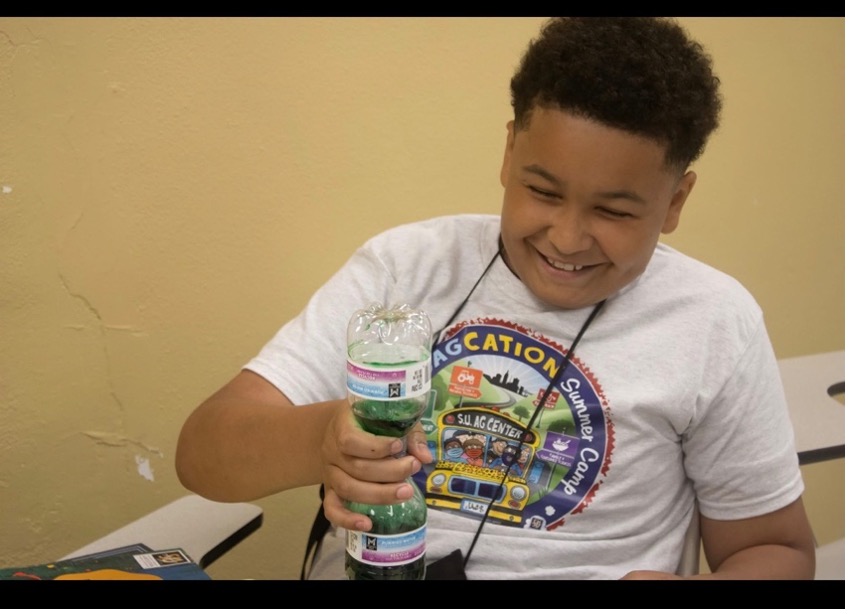
To make sure this information is shared with families, JAGriculture has a curriculum designed specifically for children. Allen emphasized that often children are the primary source for bringing resiliency education into the home. The curriculum for children provides structured lessons, age-appropriate activities, and evidence-based workshops tailored for diverse audiences—from school classrooms to community groups.
Because many lifelong Louisiana residents have lived through natural disasters and may treat them lightheartedly, a focus on children is a way to reintroduce, or begin to establish preparedness education.
“We get a bit of hesitancy, people feeling like they know it all. It can be a barrier to participation among adults. But children are so excited to get the information and they’re so excited to bring it home. So, we always empower them,” Allen said.
Student participates in hands-on disaster education activity.
For example, one of the questions they tell children to ask their parents is if the house catches fire, where does the family meet up? These types of questions put disaster planning on the minds of the parents. This training occurs with youth groups at local Boys and Girls Clubs, after school programs and youth summer programs.
“We try to make sure that our program is relevant, something they can hold on to,” Allen said, noting that youth will one day be adults and must pass information along to their future families.
In addition to the JAGriculture curriculum, the SU Ag Center also uses their Mobile Technology Center (M-TEC Unit) to travel throughout Louisiana when the power is out after a storm.
“When people have connectivity or infrastructure issues, they can use our mobile unit and complete any necessary paperwork to get assistance,” Allen said.
Furthermore, Allen said the JAGriculture curriculum is also administered to senior citizens. To reach seniors, they share the curriculum at health and community fairs.
JAGriculture was initially funded through the Extension Foundation. The program went on to receive an Extension Disaster Education Network (EDEN) mini grant for $25,000. To add value to JAGriculture, Allen mentioned conducting evaluations to determine the dollar impact of the program and to continue seeking external funds to add capacity.
Southern University is one of the 1890 Land grant Universities that actively participates in the 1890 EDEN Advisory Group (AG). The 1890 EDEN AG is a collaboration of 1890 Land-grant Universities and EDEN institutions that function within the national EDEN. The 1890 Land-grant Universities are the 19 Historically Black Colleges and Universities located primarily in the southern region of the United States. The group meets on the fourth Wednesday of the month by Zoom.
For more information about JAGriculture, contact Dr. Krystle Allen at (225) 771-3902 or krystle_allen@suagcenter.com. For more information about the 1890 EDEN AG, contact Dr. Noel M. Estwick at nmestwick@pvamu.edu or 936-261-2526.
https://extensiondisaster.net/wp-content/uploads/2026/03/eden-logo-for-web-2.png00ellenkrugel@extension.orghttps://extensiondisaster.net/wp-content/uploads/2026/03/eden-logo-for-web-2.pngellenkrugel@extension.org2025-12-11 05:27:002025-12-11 05:27:00Southern University Ag Center uses “JAGriculture” to teach disaster preparedness education
All poster abstracts must be submitted electronically using the online form. Poster authors should plan to attend the 2026 EDEN Spring Training (February 24-26, 2026 in Tampa, Florida) in person. A poster session will be held during the event, and presenters will be expected to stand with their posters during the session for discussion.
Poster dimensions are 36″ x 48″.
Topics of Interest
Submissions should demonstrate strong subject knowledge and address one or more of the following areas:
Current issues in disaster education and management, including approaches used by Cooperative Extension Systems and partners such as Sea Grant
Research and practice in disaster planning, preparedness, mitigation, response, recovery, and resilience
Successful internal and external partnerships and collaborations
Innovative curricula, programs, or projects, including those funded by USDA NIFA or EDEN Initiative programs
Emerging issues in disaster education and management that have implications for Cooperative Extension and affiliated partners
Applied research that supports Extension’s historical roles in disaster-related outreach
Research addressing systematic response, recovery, and community resilience, including lessons learned
Submission Information
The submission form will request:
Poster title
Author name(s) and institution(s) (as printed in the program)
We look forward to showcasing impactful work from across the network at the 2026 EDEN Spring Training. Thank you for contributing your expertise and advancing disaster education through research, innovation, and collaboration.
https://extensiondisaster.net/wp-content/uploads/2026/03/eden-logo-for-web-2.png00ellenkrugel@extension.orghttps://extensiondisaster.net/wp-content/uploads/2026/03/eden-logo-for-web-2.pngellenkrugel@extension.org2025-12-09 14:45:512025-12-09 14:45:512026 EDEN Annual Conference Call for Poster Abstracts
Members of the 1890-Extension Disaster Education Network (EDEN) Advisory Group (AG) photographed during the EDEN conference in Portland, Maine.
The 1890-Extension Disaster Education Network (EDEN) Advisory Group (AG) met in Portland, Maine, on October 20, 2025, a day before the annual EDEN Conference to conduct its annual face-to-face meeting.
Noel M. Estwick, Ph.D., project principal investigator (PI) and assistant professor of agribusiness and research scientist for the College of Agriculture, Food and Natural Resources at Prairie View A & M University, focused the meeting on planning and projecting priorities for the AG to engage its stakeholders.
The 2025 full-day meeting was entitled, “Charting the Course: Shaping the Future of 1890-EDEN.” During the meeting, the AG discussed how to leverage resources across the 1890 network. They also discussed how to work with collaborators, and with EDEN and its partners to foster research-driven disaster capacity.
Topics discussed included the upcoming spring 2026 Farmer Bootcamp, engagement with 1994-Tribal Colleges, partnerships across sub-committees, responses to requests for proposals and EDEN webinars.
Furthermore, the AG uses the face-to-face meeting to conduct training and strategic planning. At its inception, AG members created an action plan which served as the roadmap for AG initiatives. Part of the plan included presenting webinars and delivering presentations at conferences and professional meetings.
The group also discussed current and completed projects to include two Sustainable Agriculture Research and Education (SARE) grants.
Discussions focused on the successes and next steps for the funded grant proposal, “Mobilizing Against Threats to Community Health (MATCH4).” Estwick serves as the PI for this project.
Likewise, the group discussed the progress of another SARE funded grant, “Developing a Training Program on Surviving Disasters through Risk Management Preparation and Best Management Practices for Agricultural Producers.” Michelle Eley, PhD., community and economic development specialist for North Carolina Agricultural and Technical University Extension serves as the PI for this project.
“It is critical that we pause to assess progress toward the AGs overarching goal to facilitate oversight and re-engagement of 1890 institutions in national EDEN,” Estwick said. As a result, this led the AG to discuss how to leverage resources across the 1890 network, among its collaborators and within EDEN and its partners.
The 1890 EDEN AG is a collaboration of 1890 Land-grant Universities and EDEN institutions that function within the national EDEN. The 1890 Land-grant Universities are the 19 Historically Black Colleges and Universities located primarily in the southern region of the United States. The group meets on the fourth Wednesday of the month by Zoom.
For more information about the 1890 EDEN AG, contact Noel M. Estwick at nmestwick@pvamu.edu or 936-261-2526.
https://extensiondisaster.net/wp-content/uploads/2026/03/eden-logo-for-web-2.png00ellenkrugel@extension.orghttps://extensiondisaster.net/wp-content/uploads/2026/03/eden-logo-for-web-2.pngellenkrugel@extension.org2025-11-20 12:06:342025-11-20 12:06:341890 EDEN Advisory Group casts vision for 2026 and beyond